Wheels Through Time: Kyoto’s Hidden Architectural Gems Only Drivers Discover
Have you ever imagined cruising through ancient streets where every turn reveals a piece of history carved in wood and stone? I did—behind the wheel of a compact rental car, weaving through Kyoto’s quiet backroads. Away from crowded buses and tourist trails, self-driving unveiled something unexpected: intimate encounters with Japan’s most breathtaking traditional architecture, tucked in forgotten alleys and mountain edges. This is not just a trip—it’s a journey into the soul of design, silence, and timeless beauty. For travelers seeking more than temple queues and postcard views, Kyoto offers a deeper narrative—one best discovered at the gentle pace of a car gliding through its hidden lanes, where centuries-old homes stand in quiet dignity, unnoticed by most.
The Freedom of the Open Road in a Historic City
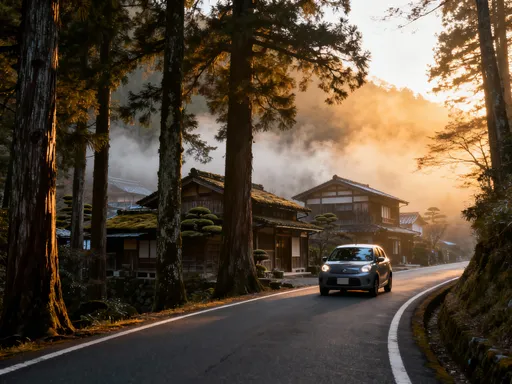
Kyoto is often experienced in snapshots: the golden glow of Kinkaku-ji, the vermilion gates of Fushimi Inari, the solemn stillness of Ryoan-ji’s rock garden. These are treasures, yes—but they represent only one layer of a city that breathes through its architecture. When approached by car, Kyoto reveals a different rhythm. The early morning light filters through wooden lattices as you navigate narrow residential streets where laundry flutters above centuries-old machiya townhouses. There are no tour groups here, no guidebooks pointing the way. Just the hum of the engine, the soft click of turn signals, and the quiet surprise of stumbling upon a weathered gate that opens to a hidden courtyard, its eaves curling like pages of an old manuscript.
Self-driving shifts the traveler’s relationship with space and time. Instead of being funneled through predictable transit routes, you move like a local—stopping where curiosity leads, lingering where beauty lingers. This autonomy allows access to architectural wonders that exist beyond the reach of buses and trains. A brief detour down a one-way lane in Sakyo Ward might lead to a restored Edo-period merchant house, its *kōshi* windows still intact, or a 19th-century *minka* farmhouse nestled beside a rice paddy, its thatched roof golden in the autumn sun. These are not museum pieces behind ropes, but living structures—some still inhabited, others gently repurposed—preserving the craftsmanship of a bygone era.
The value of this freedom lies not just in convenience, but in intimacy. Kyoto’s architectural soul is not confined to its famous temples; it pulses through its residential fabric. Driving allows you to witness how homes are arranged around inner gardens, how rooflines follow the contours of hills, and how even modern renovations honor the language of wood and tile. In the stillness of a Sunday morning drive through Yamashina, you might see an elderly couple tending a moss garden behind a latticed fence, their home a perfect example of *shoin-zukuri* design. These are fleeting, unscripted moments—made possible only by the quiet independence of the open road.
Why Self-Driving in Kyoto? Breaking Free from Tourist Routines
Most visitors to Japan rely on the country’s impeccable public transportation, and for good reason: Kyoto’s subway and bus lines efficiently connect major attractions. Yet this very efficiency can become a limitation. It funnels travelers into predictable patterns, creating congestion at popular sites while leaving quieter, equally significant areas overlooked. Renting a car, even for a single day, breaks this cycle. It offers the flexibility to explore at your own pace, to linger in places that speak to you, and to discover corners of Kyoto that remain untouched by mass tourism.
One of the most compelling reasons to drive is access to remote districts where architecture and nature coexist in harmony. Consider Ohara, a mountain village to the north, home to the serene Sanzen-in Temple and clusters of traditional farmhouses with deep eaves and earthen walls. Public transit requires transfers and a final uphill walk, discouraging casual visits. By car, you arrive with ease, able to park respectfully and explore the surrounding lanes where wooden homes blend into the forested hills. Similarly, Kibune—famous for its summer *kawadoko* dining platforms—is best approached by vehicle, allowing you to pause at roadside shrines and admire homes built on stilts above the rushing stream.
Practical considerations support the case for driving. An International Driving Permit (IDP) is required for most foreign visitors and can be obtained before arrival in your home country. Once in Kyoto, rental agencies at Kyoto Station and nearby airports offer compact, fuel-efficient vehicles ideal for narrow streets. Parking is manageable with planning: many neighborhoods have small coin-operated lots, and some guesthouses provide spaces for guests. Navigating one-way alleys requires patience, but GPS apps like Google Maps or Japan-specific navigation tools function reliably, especially when downloaded for offline use. The key is to embrace a slow, mindful approach—driving not to cover distance, but to deepen understanding.
The Living Canvas: Kyoto’s Architectural Identity in Wood and Tile
Kyoto is not merely a city with old buildings; it is a living archive of Japanese architectural evolution. For over a thousand years, its streets have been shaped by climate, craftsmanship, and cultural values. The result is a built environment where form follows function, and beauty arises from restraint. Traditional homes, temples, and teahouses share a vocabulary of design elements—each with meaning, each adapted to Kyoto’s humid summers and cold winters.
Among the most distinctive features is the *irimoya* roof, a two-tiered, curved design that combines elegance with practicality. Its lower slope shelters delicate wooden walls from rain, while the upper section allows hot air to rise and escape. These roofs, often covered in dark gray *kawara* tiles, create a rhythm across neighborhoods, their undulating lines echoing the surrounding mountains. Equally important are *shoji* and *amado* screens—translucent paper panels that slide open to blur the boundary between interior and garden. In spring, light filters through cherry blossoms and into a room; in winter, the same screens hold warmth while offering views of snow-dusted pines.
Timber framing, known as *daiku*, is the backbone of Kyoto’s traditional construction. Master carpenters use interlocking joints instead of nails, allowing structures to flex during earthquakes—a necessity in this seismically active region. The wood, often Japanese cypress (*hinoki*), is left unpainted to age naturally, its scent believed to purify the air and calm the mind. Over time, the grain darkens, the beams settle, and the home gains character—what the Japanese call *wabi-sabi*, the beauty of imperfection and transience.
Then there are the gates—the *kara-mon* with its sweeping, ornate curves, or the simpler *mon* that marks the entrance to a private residence. These are not just functional; they are symbolic thresholds, announcing a shift from the public world to a space of peace and order. Together, these elements form a cohesive aesthetic that has influenced Japanese design for centuries. To see them not in isolation, but as part of a lived environment, is to understand Kyoto not as a museum, but as a city that continues to honor its past through daily life.
Off-the-Beaten-Path Encounters: Hidden Districts Only Accessible by Car
Some of Kyoto’s most poignant architectural moments exist beyond walking distance, in districts where time moves slower and the built environment remains largely unchanged. These are places where families have lived for generations, where homes are maintained not for tourism, but for continuity. Driving allows access to these quiet enclaves—areas rarely included in guidebooks, yet rich with beauty.
Take Yamashina, a southeastern ward where the urban fabric gradually gives way to rice fields and forested hills. A drive through its backroads reveals clusters of *machiya*—narrow, wooden townhouses with tiled roofs and latticed fronts—that once housed artisans and merchants. Many have been carefully restored, their interiors converted into small galleries or family-run cafes. One might stumble upon a 200-year-old dyer’s workshop, its indigo-stained walls still bearing the marks of centuries of craft. These homes, with their *tsumairi* layout (entry at the gable end), were designed for privacy and airflow—a response to Kyoto’s dense neighborhoods and hot summers.
Fushimi’s rural outskirts offer another glimpse into architectural resilience. Away from the sake breweries that draw tourists, quiet lanes wind past *minka* farmhouses with deep eaves and earthen-floored kitchens (*doma*). These homes were built to last, their foundations raised to prevent flooding, their roofs wide to shield against rain. One such house, near the foot of Mount Kasagi, has stood since the late Edo period, its timber frame still solid, its garden a tangle of moss and maple. It is not open to the public, but visible from the road—a quiet testament to enduring design.
To the north, near Kurama and Kibune, the terrain becomes steeper, and homes adapt accordingly. Here, houses are often built into the mountainside, their *engawa* verandas extending over streams, offering views of moss-covered stones and ferns. A drive along the Kurama-dera approach road, especially in early morning mist, feels like moving through a scroll painting. Occasionally, a wooden villa appears—its roof blending with the forest canopy, its windows framed by bamboo. These are not tourist accommodations, but private retreats, some belonging to Kyoto’s artistic or scholarly families. They represent a way of living in harmony with nature—one that modern architecture often strives to emulate, but rarely achieves with such quiet grace.
Blending Old and New: Modern Architecture Nestled in Tradition
Kyoto’s architectural story is not one of preservation alone, but of evolution. While strict zoning laws protect historic districts, the city also embraces contemporary design that respects its heritage. Driving between neighborhoods offers a unique perspective on this dialogue between past and present—where a sleek concrete gallery might sit beside a 17th-century shrine, or a modern home echoes the proportions of a traditional *sukiya-zukuri* teahouse.
One of the most celebrated figures in this movement is architect Tadao Ando, whose minimalist use of concrete and light has redefined Japanese modernism. While his Church of the Light is in nearby Osaka, his influence is felt in Kyoto’s newer cultural spaces. The Oku-no-in Gallery in Yamashina, for instance, uses raw concrete walls to frame views of a moss garden, creating a meditative contrast between texture and tranquility. From the road, it appears almost hidden—its entrance modest, its form understated. Yet inside, light falls in precise patterns, honoring the same principles of balance and simplicity found in Edo-era design.
Boutique hotels and private residences also reflect this synthesis. In the northern hills, a growing number of homes combine glass walls with traditional timber frames, allowing panoramic views while maintaining a connection to local materials. Solar panels are discreetly integrated into tile roofs, and rainwater collection systems support garden irrigation—all modern solutions woven into historic forms. These buildings do not imitate the past; they converse with it, asking how ancient wisdom can inform sustainable living today.
What driving reveals is not a clash of styles, but a continuum. A new community center in Ohara might use exposed beams and sliding screens, not as nostalgic decoration, but as functional, climate-responsive elements. A small café in Kibune could feature a thatched roof made with modern, fire-resistant materials—honoring tradition while ensuring safety. These are quiet revolutions, visible only to those who move slowly, who look beyond the obvious. They show that Kyoto’s architectural legacy is not frozen, but alive—adapting, breathing, and enduring.
Practical Tips for the Road-Tripping Architectural Explorer
Exploring Kyoto by car requires preparation, but the rewards far outweigh the effort. To make the most of your journey, consider timing and tools. Early mornings and weekdays are ideal—fewer cars, softer light, and a greater chance of witnessing daily life unfold. Sunrise drives along the Kamo River toward Demachiyanagi offer golden views of wooden homes reflected in the water, their silhouettes sharp against the mist.
Navigation is straightforward with the right apps. Google Maps works well in Kyoto, but downloading offline maps ensures reliability in mountainous areas with spotty signals. Japan-specific apps like Yahoo! Japan Car Navigation offer detailed lane guidance and real-time parking information—useful for finding coin lots in narrow districts. Always verify parking options in advance; some areas, like parts of Arashiyama, have limited spaces, and unauthorized parking can incur fines.
When planning routes, prioritize scenic drives that connect architectural highlights. The road from Kurama to Kibune, for example, follows a forested stream and passes several historic villas and shrines. The route through Fushimi’s countryside offers views of traditional farmhouses and seasonal rice fields. And the loop around Mount Hiei provides panoramic vistas of Kyoto’s urban and rural landscapes, where tiled roofs ripple like waves beneath the hills.
Respect is essential. Many of the homes you’ll see are private residences. Avoid stopping in front of gates, blocking driveways, or using flash photography. If you wish to photograph a particularly striking building, do so from the public road, and never enter without permission. Remember, you are a guest in these neighborhoods. The goal is not to collect images, but to absorb the atmosphere—to feel the weight of history in the curve of a roof, the texture of weathered wood, the silence between structures.
Beyond the Postcard—A Deeper Kyoto Revealed
The true magic of Kyoto does not lie in its famous landmarks, but in its quiet moments—the slant of afternoon light on a moss-covered wall, the sound of wind through bamboo near a centuries-old gate, the way a wooden eave shelters a stone lantern from the rain. These are the details that self-driving allows you to discover, not as a checklist, but as a slow unfolding.
For the thoughtful traveler, especially one who values depth over spectacle, the car becomes more than transportation. It becomes a vessel for contemplation, a means of moving through time as much as space. Each turn down a narrow alley, each pause at a roadside shrine, adds a layer to understanding—a city not as a destination, but as a living, breathing entity shaped by centuries of craft, care, and continuity.
Kyoto’s architectural gems are not all grand or famous. Many are humble—weathered homes, forgotten gates, quiet gardens—yet they carry the soul of the city. They remind us that beauty often resides in the ordinary, in the details that go unnoticed. For those willing to drive beyond the map, to listen to the silence between buildings, Kyoto offers not just sights, but a deeper sense of place. The road, in the end, does not just lead to hidden corners. It leads home—to a quieter, more reflective way of seeing the world.